
Welcome back, TECHxas Toast readers!
We’ve explored AI’s definition, its impact on instructional design, practical tools, ethical considerations, and even how it personalizes learning. Today, I want to bring AI into conversation with a foundational educational framework that truly benefits all learners: Universal Design for Learning (UDL).
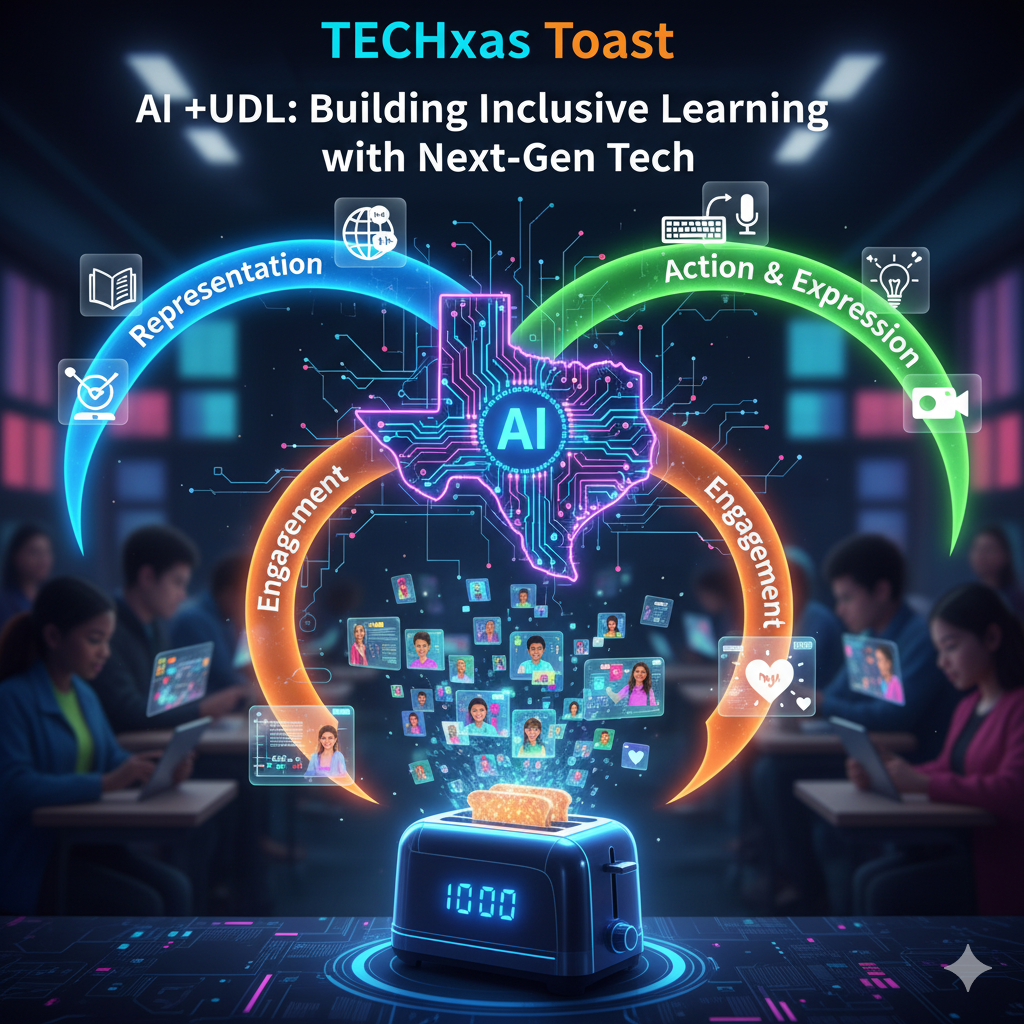
UDL is a proactive approach to designing curricula that works for the widest range of students by removing barriers to learning from the outset. It’s built on three core principles:
- Multiple Means of Representation (The “What” of Learning): Presenting information in various ways.
- Multiple Means of Action & Expression (The “How” of Learning): Offering flexible ways for students to demonstrate what they know.
- Multiple Means of Engagement (The “Why” of Learning): Tapping into learners’ interests, offering choices, and motivating them.
So, how does cutting-edge AI technology align with (and even amplify) these timeless UDL principles? Prepare to be amazed by the synergy!
1. Multiple Means of Representation: AI Broadens Access to Content
UDL calls for presenting information in diverse formats to reach all learners. AI tools are superstars here, tackling barriers related to text, language, and sensory input.
- The UDL Principle: Provide options for perception; provide options for language, mathematical expressions, and symbols; provide options for comprehension.
- How AI Helps:
- Text Adaptation (e.g., Diffit, ChatGPT/Gemini): Instantly rephrase complex articles into simpler language, adjust for different reading levels, or summarize lengthy texts. This addresses variability in background knowledge and reading fluency.
- Text-to-Speech & Speech-to-Text (e.g., Speechify, built-in device features): Convert written text into audio (and vice-versa), supporting students with reading difficulties, visual impairments, or those who benefit from auditory processing.
- Translation & Multilingual Support: AI tools can translate content into various languages, making materials accessible to English Language Learners (ELLs) and fostering a more inclusive environment.
- Visual Generation (e.g., Canva’s Magic Studio): Quickly create relevant images, diagrams, or infographics to complement text, catering to visual learners and enhancing comprehension.
2. Multiple Means of Action & Expression: AI Empowers Diverse Demonstrations
UDL advocates for giving students flexible ways to express their understanding, moving beyond traditional pen-and-paper essays. AI greatly expands these options.
- The UDL Principle: Provide options for physical action; provide options for expression and communication; provide options for executive functions.
- How AI Helps:
- Brainstorming & Outlining (e.g., ChatGPT/Gemini, NotebookLM): Students can use AI as a thought partner to generate ideas, organize their thoughts, or create initial outlines for essays, presentations, or projects, reducing the cognitive load of getting started.
- Writing Support (e.g., QuillBot, Brisk Teaching, Grammarly AI): AI can assist with grammar, spelling, style refinement, and paraphrasing, allowing students to focus on conveying their ideas effectively rather than being bogged down by mechanics.
- Multimedia Creation (e.g., Suno, Canva’s Magic Studio, Synthesia): Students can use AI to generate original music for projects, create voiceovers for presentations, design compelling visuals, or even produce short AI-narrated videos, offering creative alternatives to written reports.
- Speech-to-Text for Expression: Students can dictate their thoughts and ideas, which AI converts to text, bypassing barriers associated with typing or handwriting.
3. Multiple Means of Engagement: AI Ignites Interest & Sustains Effort
UDL emphasizes the “why” of learning – motivating students and sustaining their effort. AI can help personalize challenges, offer novel experiences, and provide targeted feedback.
- The UDL Principle: Provide options for recruiting interest; provide options for sustaining effort and persistence; provide options for self-regulation.
- How AI Helps:
- Personalized Learning Pathways (e.g., Adaptive Learning Platforms, Intelligent Tutoring Systems): AI can adjust content difficulty, provide immediate feedback, and suggest next steps based on a student’s real-time performance and interests, keeping them optimally challenged and engaged.
- Interactive Content (e.g., Curipod, AI-generated game scenarios): AI can help create dynamic quizzes, interactive lessons, or even generate characters/scenarios for role-playing, making learning more immersive and relevant.
- Choice & Voice: By handling some of the content creation tasks, AI frees up educators to offer students more choices in how they learn and how they demonstrate mastery, fostering autonomy.
- Goal Setting & Self-Regulation: AI tools can help students break down large tasks, suggest strategies, and provide prompts for reflection on their learning process.
The Power of Proactive Inclusion
AI isn’t just a set of cool tools; when viewed through the lens of UDL, it becomes an incredibly powerful enabler for truly inclusive education. By leveraging AI to provide multiple means of representation, action/expression, and engagement, instructional designers and educators can proactively dismantle learning barriers, ensuring every student has equitable opportunities to learn, grow, and succeed.
This isn’t just about making learning easier; it’s about making it possible and meaningful for more students than ever before.
How do you see AI enhancing your UDL efforts in the classroom? Share your thoughts in the comments!
Note: This blog post was written with the assistance of Gemini, an AI language model.
 TECHxas Toast
Leave a comment