
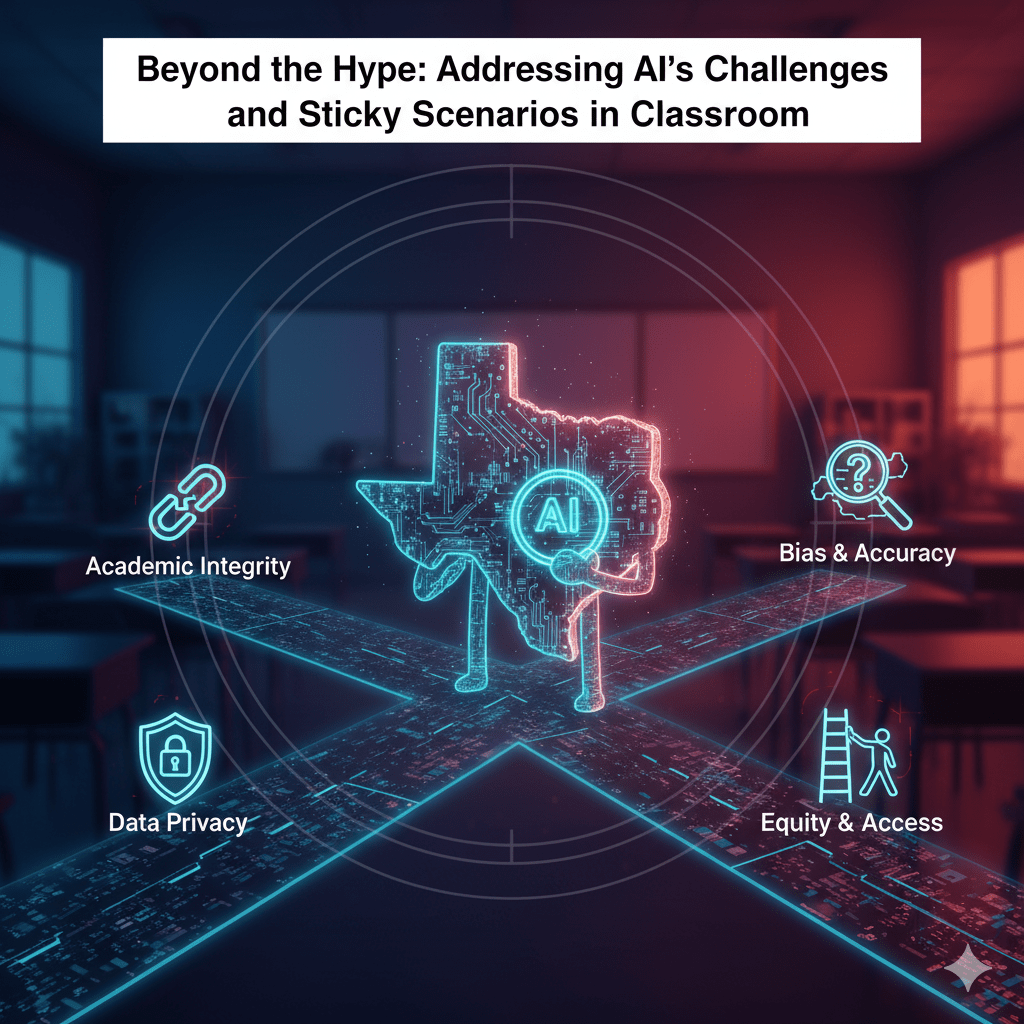
Embracing AI isn’t about ignoring its complexities; it’s about understanding them, preparing for them, and developing strategies to navigate them responsibly. Let’s dive into some common challenges and scenarios educators are facing.
Challenge 1: Academic Integrity and the “AI Cheating” Dilemma
Perhaps the most immediate concern for many educators is the potential for students to use AI tools like chatbots to generate assignments, leading to plagiarism.
- The Scenario: A student submits an essay that is suspiciously well-written, devoid of their usual errors, or contains information that seems beyond their typical grasp.
- Your Strategy:
- Redesign Assignments: Move beyond easily generatable essays. Focus on critical thinking, personal reflection, specific details from classroom discussions, process-based assignments (show your work, explain your steps), or tasks that require real-world application.
- Embrace AI as a Tool, Not a Crutch: Teach students how to use AI ethically for brainstorming, outlining, grammar checking, or even initial drafting, but emphasize that the critical thinking, analysis, and final synthesis must be theirs.
- Focus on the Process: Require students to submit outlines, multiple drafts, source annotations, or even a brief reflection on how they used (or didn’t use) AI in their work.
- Open Conversations: Talk openly with students about AI’s capabilities and ethical boundaries. Help them understand what constitutes academic dishonesty in the AI era.
- Limitations of Detection: Be aware that AI detection tools are imperfect. Relying solely on them can lead to false positives and negatives. Trust your knowledge of your students and their abilities.
Challenge 2: Bias, Accuracy, and the “Hallucinating” AI
AI models are trained on vast datasets, and if those datasets contain biases (which most do, as they reflect human-created content), the AI can perpetuate or even amplify them. AI can also “hallucinate,” confidently presenting false information as fact.
- The Scenario: An AI tool generates content that contains stereotypes, misrepresents facts, or provides an incomplete perspective on a topic.
- Your Strategy:
- Critical Evaluation is Key: This is where AI literacy (which we discussed in the last post!) becomes paramount. Teach students (and practice yourself) to question AI outputs. Where did this information come from? Is it balanced? Are there missing perspectives?
- Verify, Verify, Verify: Always cross-reference AI-generated information with reliable sources. Never treat AI as the sole source of truth.
- Diversify AI Tools: Different AI models have different training data and strengths. Using a variety of tools can help identify biases.
- Acknowledge Limitations: Remind students and yourself that AI is a tool, not an oracle. Its knowledge is based on its training data, which has a cutoff point and inherent biases.
Challenge 3: Data Privacy and Security Concerns
Using online AI tools often involves inputting data, sometimes student data. Understanding how this data is handled is crucial.
- The Scenario: You’re excited to use a new AI tool for personalized learning, but you’re unsure about its data privacy policy, especially concerning student information.
- Your Strategy:
- Review Terms of Service: Always read the privacy policy and terms of service for any new AI tool, especially before using it with student data. Look for information on data storage, usage, and deletion.
- Prioritize School-Approved Tools: Whenever possible, use tools that your school district has vetted and approved, as they often have agreements in place to protect student data.
- Anonymize When Possible: If using student work for analysis or examples, anonymize it to protect identities.
- Educate Students on Digital Footprints: Teach students about responsible online behavior and what kind of information they should and shouldn’t share.
- “No Student Data” Policy: When in doubt, adopt a “no student personally identifiable information” policy for non-school-approved AI tools.
Challenge 4: Equity and Access (The Digital Divide 2.0)
While many free AI tools exist, reliable internet access, compatible devices, and digital literacy skills are still not universally available, potentially widening existing educational gaps.
- The Scenario: Some students in your class have easy access to powerful devices and internet at home, allowing them to experiment with AI tools, while others do not.
- Your Strategy:
- In-Class AI Opportunities: Integrate AI tool usage into classroom activities where all students have equal access to devices and internet.
- Low-Tech AI Integration: Find ways to teach AI concepts and critical thinking without requiring advanced technology (e.g., discussions, role-playing AI scenarios, analyzing AI outputs you generate).
- Leverage School Resources: Advocate for school resources like computer labs, library access, or device loan programs.
- Focus on Concepts Over Tools: While tools are great, the underlying concepts of AI literacy are what truly empower students, regardless of tool access.
Embracing the Nuance
The integration of AI into education is not a smooth, perfectly paved road. There will be bumps, detours, and unexpected challenges. However, by proactively understanding these issues and developing thoughtful strategies, we can leverage AI’s immense power while ensuring our classrooms remain places of integrity, equity, and genuine learning.
What challenges have you encountered with AI in your classroom, and how have you addressed them? Share your insights in the comments below!
Note: This blog post was written with the assistance of Gemini, an AI language model.
 TECHxas Toast
Leave a comment