
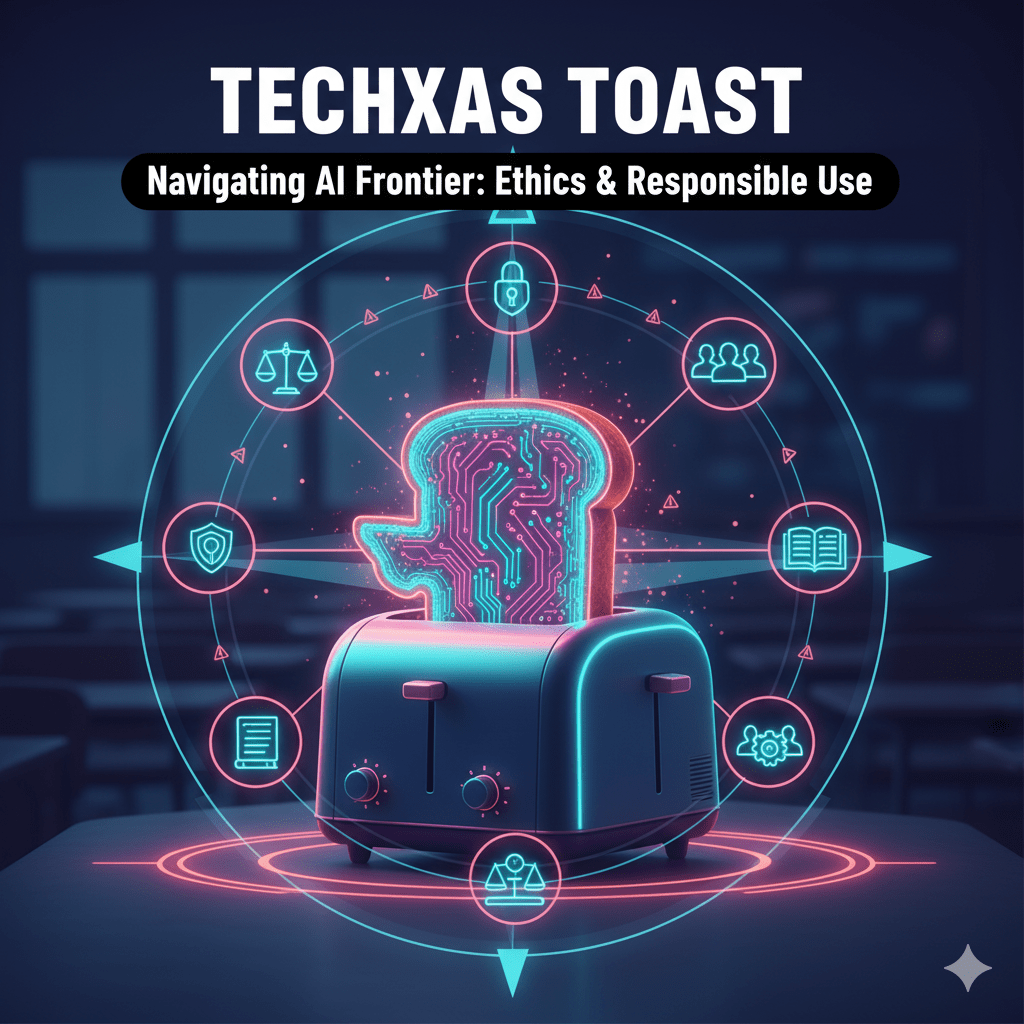
Hello, TECHxas Toast community!
In our journey exploring AI in education, we’ve celebrated its potential for innovation, efficiency, and personalization. We’ve learned what AI is, how to prompt it, and practical ways to use it in the classroom. Now, it’s time for a crucial, yet often overlooked, part of the conversation: the ethical considerations, issues of equity, and the paramount importance of responsible AI use in education.
As educators, our primary responsibility is to foster a safe, fair, and enriching learning environment. The rapid evolution of AI demands that we approach its integration with thoughtful consideration and a proactive stance on its potential pitfalls.
1. Academic Integrity: The AI “Ghostwriter” Dilemma
This is perhaps the most immediate concern for many educators. With tools like ChatGPT/Gemini, students can generate essays, code, and answers with alarming speed.
- The Challenge: How do we ensure students are still developing critical thinking and writing skills when AI can do the heavy lifting? How do we detect AI-generated work?
- Responsible Approach:
- Shift Assessments: Focus more on in-class writing, presentations, discussions, and projects that require unique thought processes or real-world application that AI can’t easily replicate.
- Teach AI Literacy: Instead of banning AI, teach students how to use it responsibly as a brainstorming tool, editor, or research assistant, much like they would use a calculator for math or spell check for writing. Explicitly discuss proper citation and ethical use.
- Emphasize Process over Product: Value the thinking, drafting, and revision process. Require students to show their work, demonstrate their learning journey, and articulate their own ideas.
2. Bias in AI: Ensuring Fair and Equitable Learning
AI models are trained on vast datasets. If those datasets contain biases (which they often do, reflecting societal biases), the AI’s outputs can perpetuate or even amplify those biases.
- The Challenge: AI could inadvertently generate biased content, provide inequitable feedback, or make unfair recommendations that negatively impact certain student groups (e.g., based on race, gender, socioeconomic status).
- Responsible Approach:
- Critical Evaluation: Teach both yourself and your students to critically evaluate AI outputs. Question the source, the perspective, and potential underlying biases.
- Diverse Data Awareness: Advocate for and use AI tools that prioritize diverse and inclusive training data.
- Human Oversight: Always maintain human oversight. AI tools should inform your decisions, not make them for you. You, the educator, are the ultimate arbiter of fairness and relevance.
3. Data Privacy and Security: Protecting Our Students
Many AI ed-tech tools collect data on student interactions and performance to personalize learning. Protecting this sensitive information is paramount.
- The Challenge: Who owns the data? How is it stored? Is it shared with third parties? What are the risks of data breaches?
- Responsible Approach:
- Review Policies: Thoroughly understand the data privacy policies of any AI tool you use, especially those requiring student accounts. Prioritize tools that are transparent and have robust security measures.
- Minimize Data Sharing: Only share the data absolutely necessary for the tool to function.
- District Guidelines: Adhere strictly to your school district’s policies on student data privacy and approved technology vendors.
4. Equity and Access: Bridging the Digital Divide
While AI promises personalization, it also risks exacerbating existing inequalities if access isn’t universal.
- The Challenge: Not all students have equal access to reliable internet, devices, or the digital literacy skills needed to effectively use AI tools outside of school.
- Responsible Approach:
- In-School Access: Prioritize providing access to AI tools within the classroom and school environment.
- Consider Alternatives: Design instruction that integrates AI but also offers alternative pathways for students who lack home access.
- Skill Building: Explicitly teach AI literacy skills to all students, ensuring they are equipped to navigate this new landscape regardless of their background.
5. The “Human Element”: Where AI Enhances, Not Replaces
Perhaps the most fundamental ethical consideration is remembering AI’s purpose. It’s a tool to augment human capabilities, not to replace the essential human connection and nuanced judgment that define teaching and learning.
- Responsible Approach:
- Focus on Relationships: Use AI to free up time for more meaningful interactions with students, deeper discussions, and personalized support.
- Value Human Creativity: Encourage students to use AI as a spring-board for their own original thoughts and creative expressions.
- Maintain Critical Thinking: AI generates information, but humans must evaluate it, synthesize it, and apply wisdom. Teach students to be critical consumers and creators with AI.
Navigating the AI frontier in education is a complex but necessary journey. By proactively addressing these ethical and equity considerations, we can harness AI’s incredible power responsibly, creating truly innovative and inclusive learning experiences for all.
What ethical dilemmas have you encountered with AI in education? Share your thoughts and strategies in the comments below!
Note: This blog post was written with the assistance of Gemini, an AI language model.
 TECHxas Toast
Leave a comment