
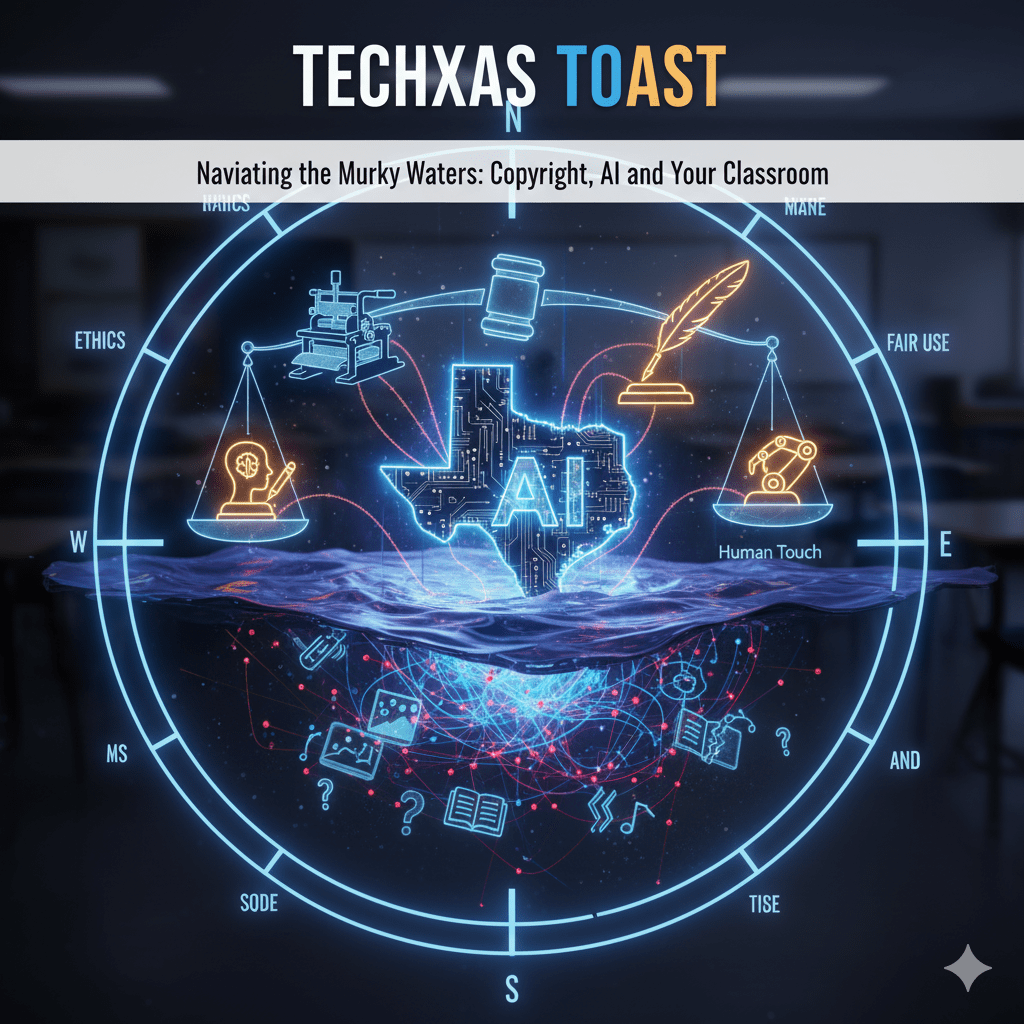
Welcome back, TECHxas Toast readers!
The intersection of Artificial Intelligence and copyright law is one of the most dynamic, debated, and frankly, confusing areas in the legal and creative world right now. For educators, understanding the basics – and the uncertainties – is crucial to using AI responsibly and protecting both your work and the integrity of your classroom.
Let’s dive into these murky waters.
The Two Sides of the AI Copyright Coin
When we talk about AI and copyright, there are typically two main considerations:
- Copyright of AI-Generated Content (Output): Who owns the original content created by an AI?
- Copyright of AI Training Data (Input): Does using copyrighted material to train an AI infringe on the original creators’ rights?
1. Copyright of AI-Generated Content (The Output)
This is perhaps the most immediate concern for educators creating materials with AI.
- The Current Stance (Mostly No): In many jurisdictions, including the United States, current copyright law generally requires human authorship. This means if an AI generates an image, text, or music without significant human creative input, it typically cannot be copyrighted. The AI itself cannot be considered an “author.”
- What this means for you: If you use AI to generate an essay, an image, or a song, you likely cannot claim copyright protection over that raw, unedited AI output.
- The “Human Touch” is Key: If you significantly modify, edit, arrange, or add substantial original human creativity to AI-generated content, then your specific modifications and additions might be copyrightable. The more “human” creative effort infused into the final product, the more likely it is to be protectable.
- Tool-Specific Terms: Many AI tools’ Terms of Service (TOS) grant the user broad rights (including commercial use) to the content they generate, even if it’s not formally copyrighted under law. However, these are contractual agreements, not copyright grants. Always check the TOS of the specific AI tool you’re using.
- What this means for you: While you might have the right to use AI-generated content, others might also be able to use very similar AI-generated content if they use similar prompts, and you generally won’t have legal recourse against them.
2. Copyright of AI Training Data (The Input)
This is a huge legal battleground, primarily concerning the companies that build AI models.
- The Debate: AI models are trained on massive datasets, often scraped from the internet, which include countless copyrighted works (books, articles, images, music, etc.). Is this “fair use” (using copyrighted material without permission for purposes like commentary, criticism, news reporting, teaching, scholarship, or research) or is it infringement?
- No Clear Legal Precedent Yet: Courts are currently grappling with this, with various lawsuits ongoing (e.g., against OpenAI, Stability AI). The legal landscape is highly uncertain.
- What this means for you (as an educator):
- While this directly impacts the AI developers, it indirectly impacts you. If AI models are found to have infringed on copyright, their future availability or pricing could change.
- It reinforces the idea that AI outputs are derivative of existing human creations. They don’t generate truly novel ideas out of thin air but recombine and learn from patterns in their training data.
Practical Considerations for the AI-Powered Classroom
Given the evolving nature of AI and copyright, here are practical guidelines for educators:
- Teach AI Literacy AND Copyright Literacy: These go hand-in-hand. Teach students that AI outputs are not inherently copyrighted and why that matters. Discuss fair use, proper citation, and intellectual property in the AI age.
- Emphasize Human Creativity: Always prioritize and celebrate original human thought and creativity. Position AI as a tool for assistance, brainstorming, or enhancement, not a replacement for original work.
- Attribute AI Use: When you (or students) use AI to generate content for public-facing projects or assignments, it’s good practice to clearly state that AI was used and how. This models transparency and ethical use (e.g., “AI-generated image via [Tool Name] with human edits,” or “Essay outline drafted using ChatGPT”).
- Be Cautious with Commercial Use: If you plan to use AI-generated content for anything commercial (e.g., selling educational resources), exercise extreme caution. Consult legal advice, and ensure your “human touch” is significant enough to warrant copyright.
- Prioritize Licensed/Public Domain Sources: When training your own small-scale AI models or providing input data to an AI tool, if you’re concerned about copyright, stick to public domain materials or content you have a license to use.
- Stay Informed: The laws and company policies around AI and copyright are changing rapidly. Keep an eye on reputable news sources and educational technology updates.
The fusion of AI and education is incredibly exciting, but it demands a thoughtful and informed approach to intellectual property. By understanding the current landscape and modeling responsible practices, we can harness AI’s power while respecting the creators who fuel its intelligence.
What are your biggest questions or concerns about AI and copyright? Share them in the comments!
Note: This blog post was written with the assistance of Gemini, an AI language model.
 TECHxas Toast
Leave a comment